


The Small-Airport Trap: Why You May Need to Arrive Earlier Than You Think
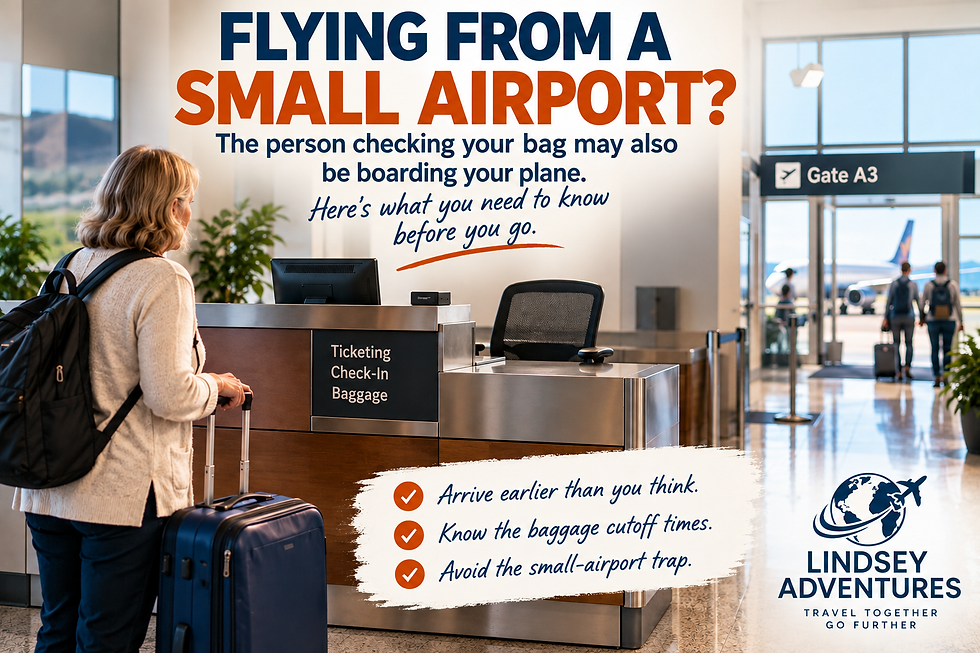
One of the great things about flying from a smaller airport is convenience.
Shorter lines.
Smaller terminals.
Easier parking.
Sometimes you can practically see your gate from the front door.
And that convenience can create a dangerous travel habit:
“It’s a small airport. I don't need to get there that early.”
These days, you might want to rethink that.
Person Checking Your Bag May Also Help With Boarding
At some smaller and regional airports, airlines don't have separate teams of employees permanently stationed at the ticket counter and gate.
The same employees may perform several jobs.
They check passengers in.
They accept luggage.
Then, as departure approaches, they may leave the counter and move to the gate or aircraft to handle the next part of the operation.
In other words, an empty airline counter doesn't necessarily mean nobody showed up for work.
It may mean the people who were behind the counter are now working your flight somewhere else in the terminal.
United Ground Express, which provides ground handling at more than 60 airline stations, describes its customer-service work as covering everything from ticket-counter check-in and baggage to gate operations and boarding.
And this isn't unique to United.
Alaska Airlines actually warns passengers at Bozeman Yellowstone International Airport that its counter may be unstaffed because agents are working the aircraft on the ground.
That matters if you're standing in the lobby holding a suitcase.
A Recent Traveler Learned This the Hard Way
A recent United passenger described arriving at a small airport and discovering nobody at the ticket counter.
The traveler had checked luggage that couldn't be taken through security, so simply proceeding to the gate wasn't an option.
Calls were made. Time passed.
The passenger eventually missed the flight.
Other travelers responding to the story pointed out something we've heard repeatedly from experienced small-airport travelers: at smaller stations, the person working check-in may also be the person working your gate.
That's an important distinction because many of us think about airport arrival time primarily in terms of TSA.
We ask:
“How long will security take?”
But if you're checking luggage, that's only half the equation.
The more important question may be:
“How long will the airline counter be available?”
The 45-Minute Rule Isn't an Arrival Time
Here's another important distinction.
Most major airlines have firm baggage/check-in deadlines.
American generally requires checked baggage for domestic flights to be accepted at least 45 minutes before departure, although some airports require more time. Delta also generally requires domestic checked baggage at least 45 minutes before departure.
Those are cutoff times, not suggested airport arrival times.
If your flight leaves at 10:00 a.m., a 45-minute baggage cutoff does NOT mean you should walk through the airport doors at 9:15.
You need to have reached the counter, completed the process and had your bag accepted by then.
And at a smaller airport with fewer employees, cutting it close can become an even bigger gamble. Ironically, the airport that normally gets you from parking lot to gate in 15 minutes may be the airport where you should give yourself more cushion when checking luggage.
WHAT THIS MEANS TO YOU
At Lindsey Adventures, we love smaller airports. They're often easier to navigate, less intimidating, and considerably less stressful than a giant hub.
But don't let easy become late.
Here are our rules for taking advantage of a smaller airport without letting its convenience bite you:
1. With a checked bag, aim for two hours before departure.Yes, even at the little airport where you've gotten from your car to the gate in 20 minutes. Consider the extra time cheap travel insurance.
2. Check in on the airline app the day before. Download the airline's app, check in when it opens, and make sure your reservation and boarding pass are ready. This doesn't eliminate the need to drop your suitcase, but it eliminates one potential problem.
3. Check your specific airport's baggage cutoff — not just the airline's general rule. Some airports have earlier requirements. International flights can also require considerably more time.
4. Don't assume a delayed flight means you can arrive later. This one is especially important. Ticket-counter and baggage procedures may still be based on the original schedule, and the employees may need to move to other duties. A two-hour delay on your phone is not permission to spend another hour at home.
5. If you require counter assistance, build in even more time. Wheelchairs, mobility devices, oversized baggage, document verification, and international itineraries can all require assistance that a kiosk can't provide.
6. If the counter is unexpectedly empty, act immediately. Don't stand there for 20 or 30 minutes hoping someone appears. Call the airline, look for posted counter hours or instructions, and document when you arrived. If there's a problem later, having a record of your arrival and attempts to get assistance can matter.
And perhaps the simplest Lindsey Adventures rule:
The smaller the airport, the smaller the stress — but not necessarily the smaller the arrival window.
Getting to the airport early may mean an extra cup of coffee and 45 minutes of people-watching.
Getting there late may mean watching your airplane leave without you. We'll take the coffee.


Comments